
Metal Roofing Design Center
Standing seam and stone-coated steel — compare the panel options, see why metal is about more than cost, and browse every color on one page.
Metal roof options we install
Four ways to put metal on a Florida home. Each one is installed to the tested assembly in its Florida Product Approval.
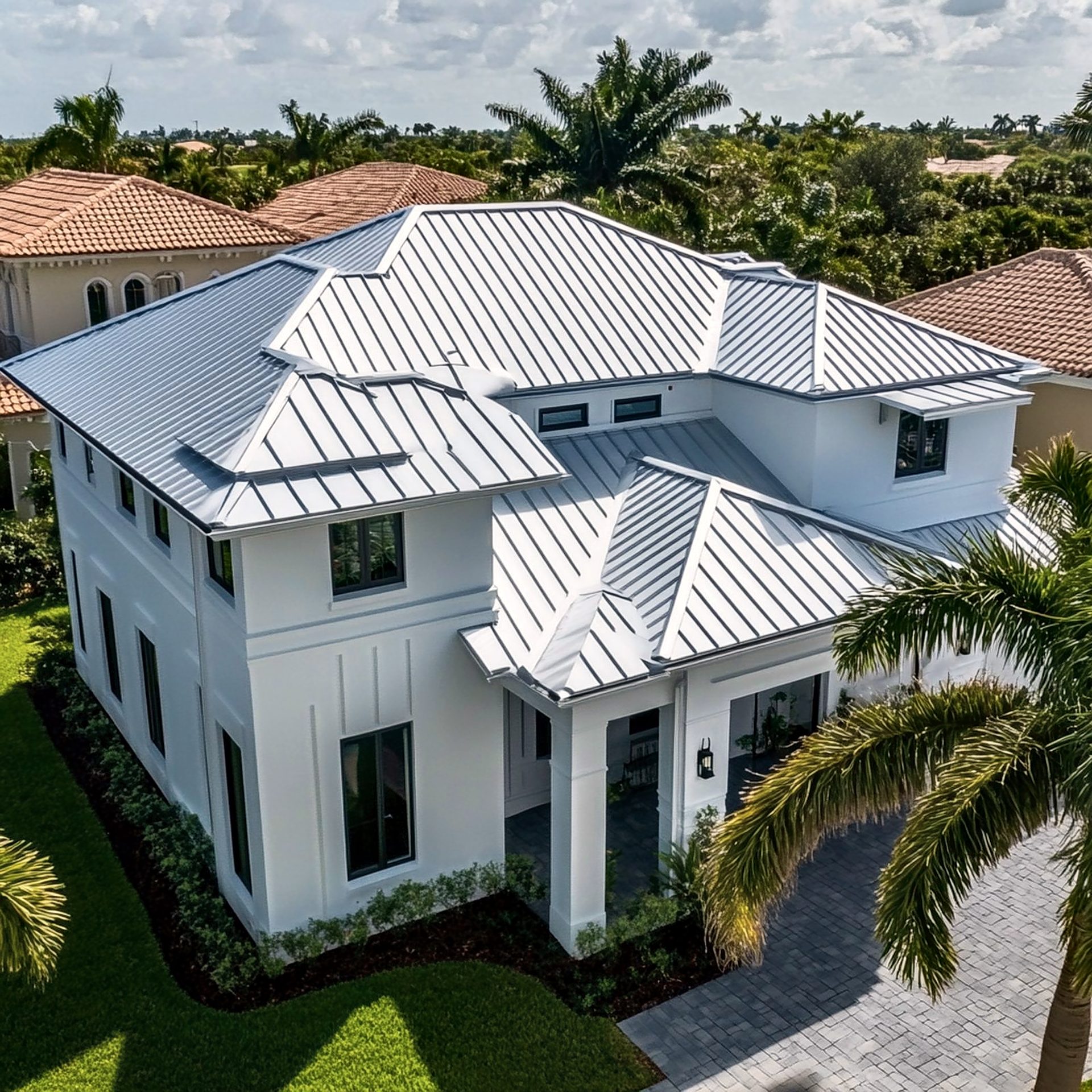
1″ Snap-Lock
A low, crisp seam with fasteners hidden under the panel — a painted finish and a clean, modern line.
See the 1″ panel →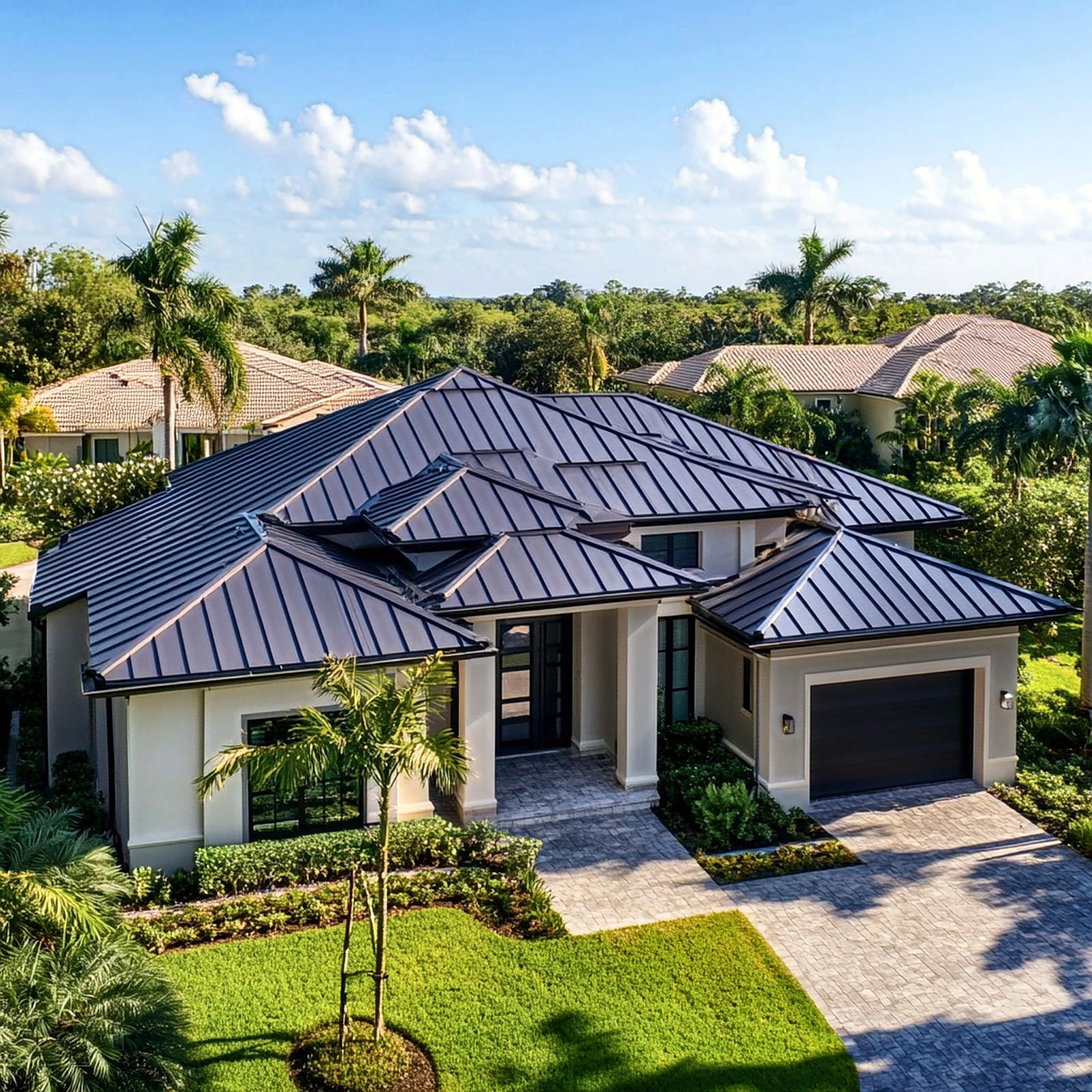
1.5″ Snap-Lock
A taller, bolder seam with concealed fasteners — available with a Kynar 500® (PVDF) finish.
See the 1.5″ panel →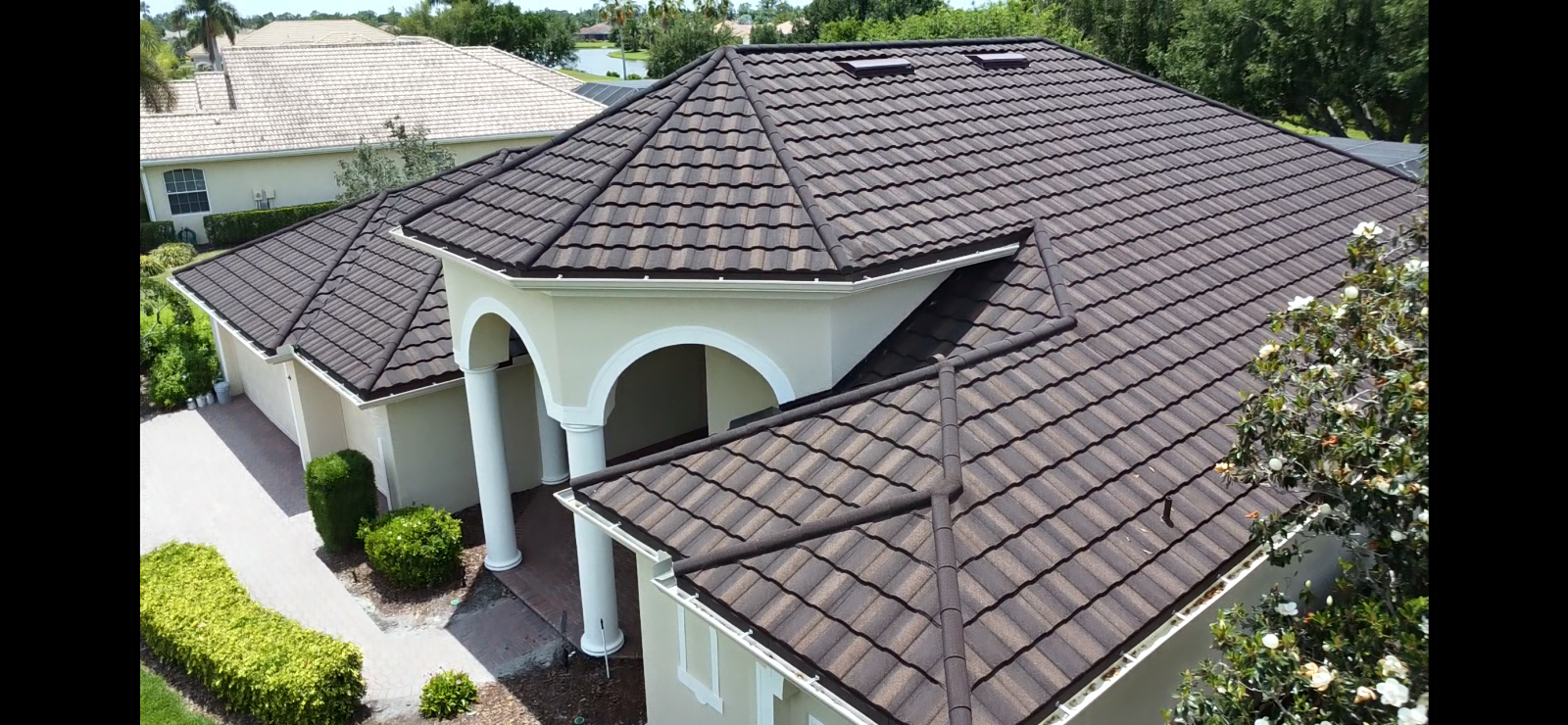
Stone-Coated Steel
Steel panels finished in bonded stone granules, shaped like tile, shake or shingle.
Explore stone-coated →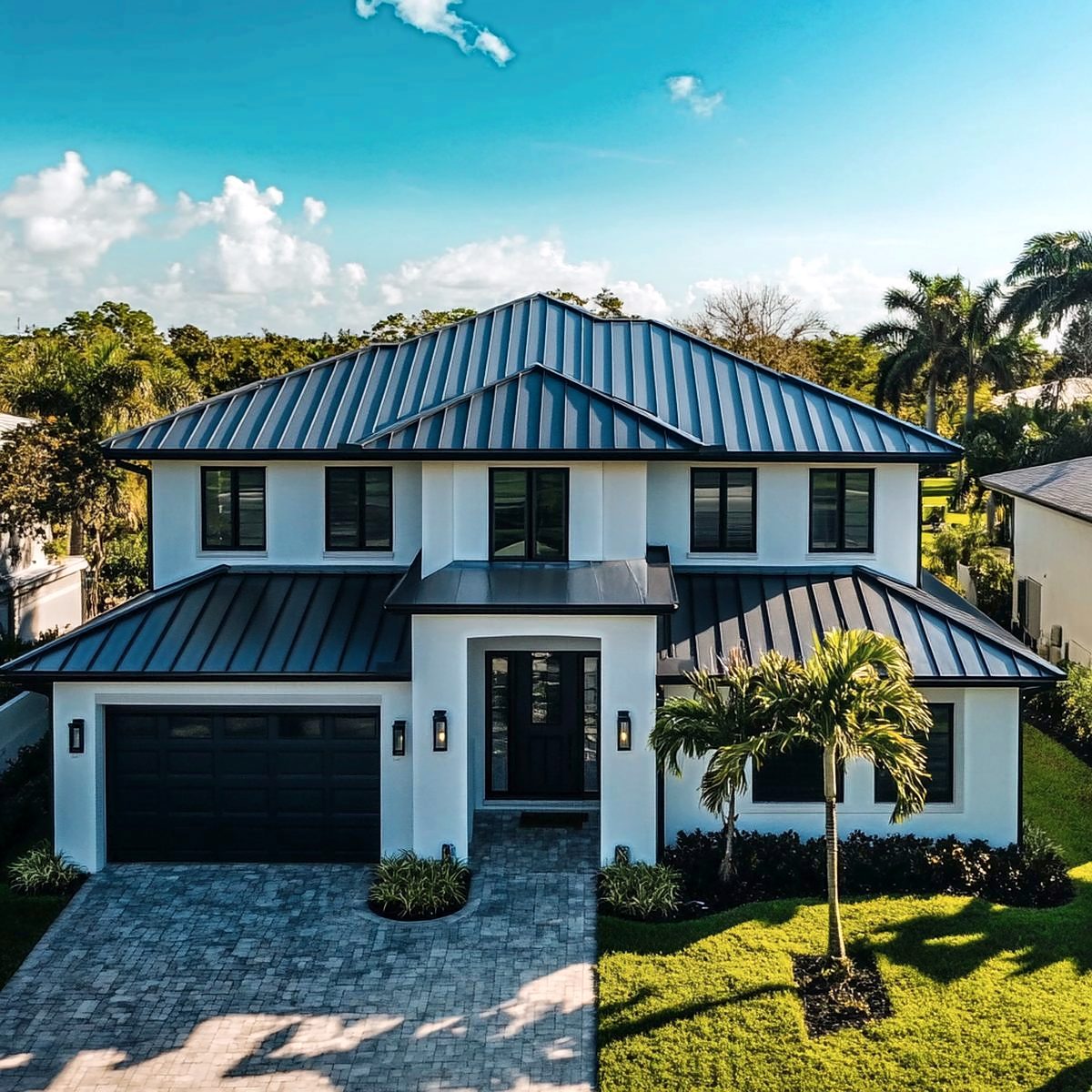
Nailstrip, Mechanical Seam & 5V
The rest of the standing seam family, plus the exposed-fastener 5V crimp.
See every profile →Home Visualizer
See it on your house
Try metal colors from the brands we install on your house with our free Home Visualizer, then bring your short list to your free inspection.
Open the Home Visualizer →Standing seam snap-lock: 1″ or 1.5″
Both are snap-lock standing seam panels: each panel is fastened to the deck through a hidden nailing flange, and the next panel snaps over it, so no screw ever goes through the face of the roof. The difference is the height of the seam — and the finish options that come with it.
1″ Snap-Lock
Painted finish- Concealed fasteners — nothing exposed to the weather
- Low 1″ seam for a slim, understated profile
- Painted finish from the standard color palette
- Panel face: striated or flat (see below)
1.5″ Snap-Lock
Kynar 500® option- Concealed fasteners — nothing exposed to the weather
- Taller 1.5″ seam for stronger shadow lines
- Optional Kynar 500® PVDF finish for long-term color and gloss retention
- Panel face: striated or flat (see below)
What “Kynar 500®” actually means. Kynar 500® is Arkema’s PVDF resin. According to Arkema, a genuine Kynar 500® finish contains at least 70% PVDF resin, and 70% PVDF coatings meet the AAMA 2605 standard’s 10-year South Florida exposure test for color change, chalking and gloss retention — the highest of AAMA’s three architectural coating performance levels. If a quote just says “painted,” ask which coating system it is.
Panel width, gauge and the wind rating depend on the specific panel and the Florida Product Approval it’s installed under. We confirm all three in writing on your proposal rather than quoting a generic number here.
Source: Arkema — Kynar 500® specifications ↗
Why metal is more than a cost decision
Metal often costs more up front than shingles, so it gets pitched as a long-term savings play. The bigger reasons to choose it are how long it lasts, how it handles wind and sun, and what happens to it at the end of its life.
It lasts for decades
The Metal Roofing Alliance puts a metal roof’s service life at 50 years or more — two to three times that of an asphalt roof — which can mean one roof where you’d otherwise buy two or three.
It’s recyclable, start to finish
Per the Metal Roofing Alliance, metal roofing is 100% recyclable at the end of its life and typically contains at least 25% recycled content to begin with. Old shingles, by contrast, mostly go to landfill.
It’s engineered for wind
A metal roof’s wind rating belongs to the complete tested assembly — panel, clips or fasteners, and deck — listed in its Florida Product Approval. Concealed-fastener standing seam has no exposed screws to back out or leak.
It reflects Florida sun
ENERGY STAR explains that roofs with high solar reflectance and thermal emittance stay cooler — citing Lawrence Berkeley National Lab, a clean white roof reflecting 80% of sunlight stays about 50°F cooler on a summer afternoon than a gray roof reflecting 20%. Reflective coatings now exist in darker colors too; the Cool Roof Rating Council directory lists rated products.
Sources: Metal Roofing Alliance — recyclability & lifespan ↗ · ENERGY STAR — cool roofs ↗ · Florida Product Approval search ↗
Striated vs. flat panels — and why it matters
Look closely at a standing seam panel and you’ll often see faint lines running the length of the flat area between the seams. Those are striations (sometimes called pencil ribs or stiffening ribs): shallow beads rolled into the metal when the panel is formed. They’re there to deal with something every flat metal panel can show — oil canning.
What oil canning is
A visible waviness or “pillowing” in the flat of a panel, most noticeable in low, raking sunlight. The Metal Construction Association describes it as an aesthetic condition inherent to light-gauge, cold-formed metal with broad flat areas — it doesn’t typically affect the panel’s structural integrity or weather-tightness, and no manufacturer or installer can guarantee it won’t appear.
What striations do
The rolled-in lines break up the broad flat area and scatter reflected light, so any waviness is much harder to see. They also help disguise minor unevenness in the roof deck below. Striations reduce the appearance of oil canning; they don’t make the metal immune to it.
Which panels have them
Many standing seam panels — including 1″ and 1.5″ snap-lock — can be ordered with a striated, pencil-ribbed or completely flat face. It’s chosen when the panels are ordered, and availability varies by panel and supplier, so we confirm the options for your exact profile on your proposal.
Why flat can need a sign-off
Because flat panels show oil canning most, some manufacturers treat striations as the standard and ask the owner to sign a flat-panel (non-striated) acknowledgment or waiver before they’ll run the order — confirming you understand oil canning may be visible and isn’t considered a defect. If your panel needs one, we’ll walk you through it before anything is ordered.
When flat is the right choice
A flat, un-striated panel gives the cleanest, most architectural look, and plenty of homeowners choose it on purpose. It tends to work best when:
- You want the crisp, modern look and accept that some waviness may be visible in certain light.
- The roof is low-slope or not very visible from the street — oil canning is most noticeable on steeper, highly visible roof planes.
- You’re choosing a lighter or lower-gloss color — dark, glossy finishes show oil canning more.
- The panel is narrower or a heavier gauge, which resists oil canning better than a wide, thin panel.
- The deck is flat and true, and the panels are handled and fastened carefully — which is our job either way.
If none of that fits — a steep, dark, highly visible roof, say — striated panels are the safer choice, and they still read as a clean standing seam roof from the street.
Source: Metal Construction Association — oil canning technical bulletin ↗; striation and flat-panel order requirements from panel manufacturers’ published order and waiver documents.
Standing seam vs. stone-coated steel
Both are metal, both outlast a shingle roof by decades, and they suit completely different houses. Here is the honest side-by-side.
| Standing Seam Metal | Stone-Coated Steel | |
|---|---|---|
| The look | Clean, modern, unbroken vertical lines | Reads as clay tile, cedar shake, or architectural shingle |
| Fasteners | Concealed under the seam (5V is exposed) | Concealed — panels interlock |
| Weight | Light — roughly 0.7–1.5 lb/sq ft | Very light — roughly 1.2–1.4 lb/sq ft |
| Typical life in FL | 40–70 years | About 40–50+ years |
| Finish | PVDF (Kynar 500) paint, or mill | Ceramic-coated stone granules over steel |
| Texture | Smooth panel — striations, ribbon bead, or flat | Dimensional, matte, stone texture |
| Relative cost | $$$ | $$ |
| Best for | Modern and coastal homes, low-maintenance owners, long panel runs | Homes that want the tile or shake look without the weight, and HOA neighbourhoods |
| Worth knowing | Flat panels can show gentle waviness (“oil canning”); textured faces hide it | Granule finish is thicker and quieter underfoot; profile and color are chosen together |
Figures are general Florida ranges, not a promise about a specific roof. Every wind rating that matters comes from the complete tested assembly’s Florida Product Approval — we confirm the approval covering your roof before ordering.
Every metal color we can put on your roof
Your roof is the single largest block of color on your house — roughly 40% of what anyone sees when they look at it — and on a metal roof you are choosing it for 40 years or more. It is also the one material where the color does real work: a lighter, more reflective finish sends more of the Florida sun back off the house, while a dark bronze or matte black soaks it up and looks considerably more dramatic doing it.
Two things catch people out every time. Metal reads lighter on a full roof than it does on a chip in your hand, because you are seeing it across a big sloped plane in full sun. And a metal finish changes noticeably through the day as the sun angle moves across it — a chip on a table can’t show you that. So browse here, narrow it down, and let your project manager bring the real samples out to the house before anybody orders anything.
Painted metal — the PVDF (Kynar 500®) palette
Premium standing seam and 5V finishes use PVDF (Kynar 500®) paint, a fluoropolymer coating that holds its color under our sun far better than cheaper paints — which is the whole point on a roof you intend to keep for decades. The 1.5″ snap-lock is available in this finish; the 1″ snap-lock uses a standard painted finish, and we confirm its palette when your panels are ordered.
Grays & Blacks
Bronzes & Browns
Whites & Sands
Reds
Greens & Blues
Metallics & Mill
These are the standard architectural PVDF (Kynar 500) colors metal roof panels are finished in — the palette we specify from. Exact availability varies by panel profile, gauge, and substrate and is confirmed with our supplier when your panels are ordered, so treat this as your starting point rather than a stock list. Swatches are digital approximations: a metal finish shifts noticeably with gloss level, roof pitch, and the angle of the sun, and it always reads lighter on a full roof than it does on a chip. Your project manager brings the current color chips and real panel samples to your free inspection so you can hold them against your own walls.
Stone-coated steel granule blends, by profile
Stone-coated colors are blends of ceramic-coated stone granules bonded to the steel, not paint — which is exactly why they read as rich and dimensional from the street instead of flat. Each profile carries its own palette, so the profile and the color get chosen together.
Roman
Wood Shake
Shingle
Roman II
Bond
Classical
Stormetal Shingle
Swatches are digital approximations of a granule blend — the hardest kind of finish to show on a screen. What looks like one flat color here is several tones of stone catching the light differently across a roof. Availability varies by profile, and real samples come to your free inspection.
Kynar 500® is a registered trademark of Arkema Inc. Other product names and color names are the property of their respective owners. Providential Roofing & Construction installs these products — we do not manufacture them. The standing seam photos on this page are illustrative: they show the look of each system, not a Providential project. Panel dimensions, gauges, finishes and wind ratings are confirmed for your specific panel and Florida Product Approval on your proposal. Colors shown on any screen are approximate: a metal finish in particular shifts with gloss, pitch, and the angle of the sun, so ask your project manager for physical samples before you choose.
Ready to see your options in person?
Your project manager brings real samples to your free inspection — no pressure, no sales games, just an honest look from a dual-licensed contractor.
Request My Free Inspection ☎ Call (941) 226-4000