
My Safe Florida Home in 2026: What Changed for Roof Upgrades and How to Apply
Hurricane season ends Nov. 30, and the off-season is a good time to plan upgrades. A 2026 law expanded Florida's home-hardening program to attached homes, spelled out roof covering replacement, and gave grant recipients 18 months to finish.
November 9, 2026
Key takeaways
- My Safe Florida Home offers a free hurricane mitigation inspection and, for income-qualified homeowners, a grant of up to $10,000 toward recommended upgrades, subject to available funding.
- SB 1452 (effective June 26, 2026) covers attached homes up to three stories, clarifies that replacing the roof covering is grant eligible, and gives grant recipients 18 months to finish.
- Grants require a homestead, an insured value of $700,000 or less, a home built before 2008, and low or moderate household income.
- Don't sign a contract, buy materials, or start work before the program approves your grant, or you can lose the reimbursement.
Hurricane season officially ends November 30, according to the National Hurricane Center. For a lot of Manatee and Sarasota homeowners, the quieter months are when it makes sense to plan roof and opening upgrades before next June. If you're income-qualified, Florida's My Safe Florida Home program may help pay for some of that work, and the rules changed this year.
This is general information, not legal or insurance advice. The summaries below come from section 215.5586, Florida Statutes, the Florida Department of Financial Services (DFS), and the program's own published guidance as of November 9, 2026. The program and the statute have the final word, and funding can change.
What My Safe Florida Home is
My Safe Florida Home is a state program run by DFS. It has two separate parts, and each has its own application:
- A free hurricane mitigation inspection by a licensed inspector the program assigns. The report summarizes your home's current wind-resistant features, recommends improvements, gives a range of cost estimates, and includes information about possible insurance premium discounts.
- A grant to help pay for improvements that inspection recommends, for homeowners who qualify.
The statute says the program is subject to annual legislative appropriations and isn't an entitlement. Applications open in priority groups as funding allows. The program's home page currently advertises free inspections and grants of up to $10,000. Check MySafeFLHome.com for what's open to your group right now.
What changed in 2026
Senate Bill 1452 took effect June 26, 2026, when the Governor signed it. According to DFS's summary and the updated statute, it:
- Covers attached homes. A single-family unit on its own parcel can now qualify if it's detached, or attached (sharing a wall with another unit) and no more than three stories.
- Clarifies roof coverings. The list of grant-eligible roof improvements now reads "installing secondary water resistance for roof and replacing the roof covering." DFS describes this as clarifying that roof improvements, including replacing the roof covering, are grant eligible.
- Gives more time to finish. A grant recipient now has 18 months after grant approval to finish construction and request the final inspection. The program's support center says grant timelines were extended from 12 to 18 months.
- Allows a second inspection. You can apply for another program inspection if more than 24 months have passed since your last one and you didn't receive a grant payment for it.
- Requires the final inspection to confirm the work. Improvements must be identified by the final hurricane mitigation inspection to receive grant funds.
- Adds a warning before an application is abandoned. DFS must notify you at least 5 business days before treating your application as abandoned, and you can respond with good cause.
Who qualifies
For the free inspection, section 215.5586 requires a site-built, owner-occupied, single-family home on its own parcel (detached, or attached and no more than three stories) with a homestead exemption.
For a grant, the home also has to:
- Have an insured value of $700,000 or less.
- Have been built before January 1, 2008, as shown on the county property appraiser's website.
- Have had its initial program inspection within the 24 months before you apply.
- Belong to a low-income or moderate-income homeowner, as defined in section 420.0004.
You also agree to a final inspection and to share the insurance discount information you get from your insurer.
How the grant money works
- Matching grants: the state provides $2 for every $1 you pay, up to a state contribution of $10,000. The program says these are paid on a reimbursement basis after the work is done, and a paid-in-full invoice is required.
- Low-income grants: up to $10,000 with no match required.
Applications are reviewed in priority order: low-income homeowners 60 and older first, then other low-income homeowners, then moderate-income homeowners 60 and older, then other moderate-income homeowners. Homeowners above the moderate-income level can still apply for an inspection, but not a grant.
When recommended by your initial inspection, grants can go toward opening protection (exterior doors, garage doors, windows, and skylights) and roof improvements: reinforcing roof-to-wall connections, improving roof-deck attachment, and installing secondary water resistance and replacing the roof covering.
The rule that trips people up: don't start early
The program is blunt about this. Its homeowner's guide says that to be eligible for payment, you must not perform any work, sign with a contractor, or purchase materials before you get the program's email telling you to proceed. Its FAQ says beginning work before approval will disqualify you from reimbursement.
So if you're in the program, it's fine to collect bids, but hold off on signing a contract or starting work until you have that approval in writing.
What you'll need from your contractor
Under the statute, your grant application has to name the contractor you plan to use and that contractor's state license number, which the program verifies. All work must be done by properly licensed contractors with all required local permits and inspections. The program also recommends getting bids from at least three contractors. Our guide to checking a Florida contractor's license walks through how to look one up.
A simple plan for this off-season
- Go to MySafeFLHome.com, create an account, and complete the prioritization questionnaire.
- Get your free program inspection when your group is scheduled, and read the report's recommended improvements.
- If you qualify for a grant and want to proceed, gather bids from licensed contractors for the recommended items.
- Submit your grant application with your chosen contractor's name and license number, and wait for approval before signing or starting.
- Finish the work and request the final inspection within 18 months, then send the final inspection report to your insurer to ask about discounts.
Not eligible for a grant? A private wind mitigation inspection can still document your home's features for insurance discounts. Our wind mitigation discounts guide explains what that inspection measures.
Where Providential fits
Providential Roofing & Construction is a licensed roofing contractor. We don't run the program, decide eligibility, or perform the program's inspections, and nobody can move you up the line. If your program report recommends roof work, such as roof-to-wall connections, deck attachment, secondary water resistance, or a new roof covering, call us at (941) 226-4000 and ask how we can help with a bid for those items.
Frequently asked questions
Is My Safe Florida Home open right now?
The program's home page currently advertises free inspections and grants of up to $10,000, and applications open by priority group as funding allows. Funding is subject to annual legislative appropriations, so check MySafeFLHome.com for what's available to your group.
Can a townhome get a My Safe Florida Home grant?
Since SB 1452 took effect June 26, 2026, an attached single-family home on its own parcel that is no more than three stories can qualify for an inspection, and for a grant if it meets the other grant requirements.
Does My Safe Florida Home pay for a new roof?
When your initial program inspection recommends it, grant-eligible roof improvements include reinforcing roof-to-wall connections, improving roof-deck attachment, and installing secondary water resistance and replacing the roof covering. DFS says the 2026 law clarified that replacing the roof covering is grant eligible.
Can I start the work while I wait for grant approval?
No. The program says work, contracts, or material purchases before grant approval will result in a denial of reimbursement. Collect bids, but wait for the program's written approval before signing or starting.
Sources
Florida Statutes, Section 215.5586: My Safe Florida Home Program (2026) · Florida Department of Financial Services, Office of the Insurance Consumer Advocate: Property Insurance Changes (SB 1452 summary) · My Safe Florida Home: Program home page · My Safe Florida Home: Frequently Asked Questions · My Safe Florida Home: Homeowner's Guide (PDF) · My Safe Florida Home Support Center: Can I request a grant extension? · National Hurricane Center: Tropical Cyclone Climatology (Atlantic season June 1 to November 30)
General information only, not legal or insurance advice. Program details are based on section 215.5586, Florida Statutes, and published guidance from the Florida Department of Financial Services and My Safe Florida Home as of November 9, 2026. Eligibility, funding, and procedures can change. Confirm specifics with the program at MySafeFLHome.com. Providential Roofing & Construction is a licensed roofing contractor and does not administer the program or determine eligibility.
More from Providential News
 Wind Mitigation
Florida Wind Mitigation Discounts, Explained: The 9 Things Your Inspection Measures
Florida law requires insurers to offer credits for wind-resistant features. Here's what the inspection looks at, what changed in 2026, and the different kinds of discounts you may qualify for.
 Wind Mitigation
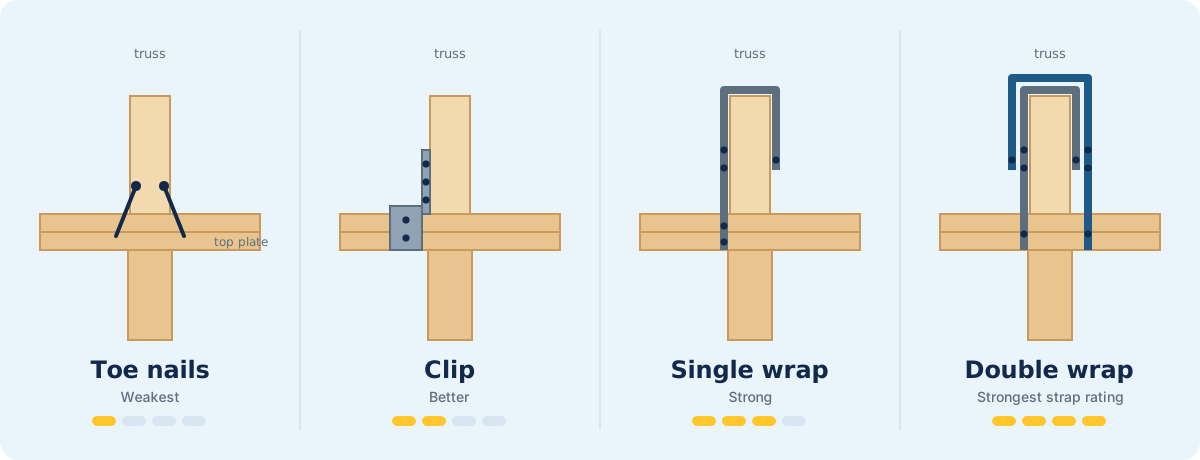
Hurricane Straps 101: Toe Nails vs. Clips vs. Single Wraps vs. Double Wraps
The metal straps that tie your roof to your walls are one of the most important items on a wind mitigation report. Here's how each type works and why double wraps come out on top.
 Wind Mitigation
How Providential Helps You Get Wind-Mitigation Ready, From Roof Deck to Paperwork
Better wind mitigation ratings come from two things: work done right, and proof that it was done. Here's how we help with both.
Ready for a free roof inspection?
No pressure, no sales games — just an honest look at your roof from a dual-licensed contractor.
Request My Free Inspection ☎ Call (941) 226-4000