
How Providential Helps You Get Wind-Mitigation Ready, From Roof Deck to Paperwork
Better wind mitigation ratings come from two things: work done right, and proof that it was done. Here's how we help with both.
October 3, 2026
Key takeaways
- Many of the features on a wind mitigation report are easiest to improve during a roof replacement: deck nailing, a sealed roof deck, a code-compliant covering, and often roof-to-wall connections.
- As a dual-licensed roofing and residential contractor, we can handle the roof and related structural work together.
- The 2026 inspection form requires photo or document proof for each feature. Documentation captured during the job matters.
- We're a contractor, not an insurance agent or adjuster. Your insurer decides the discount, and we'll be straight with you about what's worth doing.
Homeowners across Manatee and Sarasota have been asking us the same question this year: "Can my roof get me a better wind mitigation discount?" Often the answer is yes. Sometimes the honest answer is "not right now." Either way, here's how we approach it.
What we can improve, and when
The Florida wind mitigation form (OIR-B1-1802) rates several roof features. Here's how a properly permitted roof replacement can affect each one:
- Roof covering. A new roof installed under permit with Florida-approved products gives the inspector a current permit date and product approval to record. We install tile (Westlake, Eagle, Crown), asphalt shingle (GAF, Owens Corning, Atlas), standing seam metal, and stone-coated steel.
- Roof deck attachment. With the old roof off, the deck can be re-nailed to the current code schedule, which can move your home up a category on the form.
- Secondary water resistance. A sealed roof deck, like a self-adhering underlayment or taped deck seams, is far easier to add while the deck is exposed.
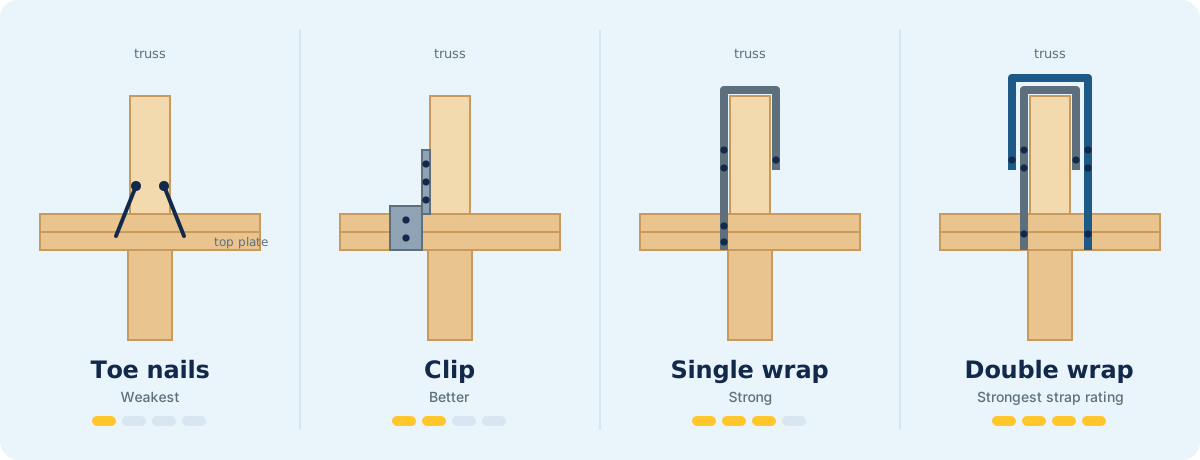
- Roof-to-wall connections. Wrapping straps over the trusses usually requires access at the eaves. A reroof is the natural time to ask about upgrading clips or toe nails toward single or double wraps. See Hurricane Straps 101.
Some items aren't really roofing decisions. Your roof's shape, the code your home was originally built under, and your wind region are what they are. Opening protection (windows, doors, shutters) is a separate project.
Why dual licensing matters here
Providential holds both a Certified Roofing Contractor license (CCC1333042) and a Certified Residential Contractor license (CRC1333797). Roof-to-wall connections are structural framing, not just roofing. When a project calls for structural work, we can handle it ourselves instead of bringing in a second contractor.
How it works
- Comprehensive free roof inspection. Every home gets one before we give an estimate. We look at your roof's condition, check for roof-to-wall clips and tell you what type you have, and talk through your goals. If you have an existing wind mitigation form, bring it, and we'll go over what it shows.
- A straight answer on what's worth doing. Some features can be improved easily during a reroof. Others, like roof shape, can't really be changed. We'll tell you which is which, and when the honest answer is to wait.
- Work done to current code, under permit. Your project manager handles material selection, permitting, and city inspections, and is on site during the build.
- Documentation you can hand to an inspector. Permit records, product information for what was installed, and photos of the work. On shingle roofs, our crews photograph the deck nailing, the nail pattern in the shingles, the starter strip, the drip edge, and the mastic over the nails on the drip edge, showing the building-code spacing, before any of it is covered up. That matters because the 2026 form requires a photo or document for each feature claimed, including roof deck attachment. Metal and tile jobs have their own documentation, so ask us what to expect for your roof.
- The inspection and your insurer. Once the work is complete, we recommend an independent third-party home inspector to verify the work and complete the official OIR-B1-1802 form. You then submit it to your carrier.
What we don't do
We're a licensed roofing and residential contractor, not an insurance agent or public adjuster. We don't set or promise discounts, interpret your policy, or give insurance advice. Your carrier decides what credits apply, and your agent is the best person to price "what if" scenarios before you commit to an upgrade.
Not sure where to start?
Read Florida wind mitigation discounts, explained for the full picture, and when you don't need an upgrade for the other side of the story. When you're ready, request a free roof inspection or call (941) 226-4000. If timing is the issue, ask about our financing options.
Frequently asked questions
Does Providential perform wind mitigation inspections?
We don't complete or sign the official wind mitigation form (OIR-B1-1802) ourselves. Every home gets our comprehensive free roof inspection before we give an estimate. It includes checking for roof-to-wall clips and telling you what type you have, so you'll know where your home stands first. We also do the upgrade work, including re-roofs, deck re-nailing, sealed roof decks, and roof-to-wall strap and connection upgrades. To verify the work and complete the official form, we recommend an independent third-party home inspector.
Will a new roof automatically lower my insurance?
Not automatically. A new roof can improve several features on your wind mitigation report, but you need an updated inspection form submitted to your insurer, and the credit depends on your carrier's rating plan.
Can you upgrade hurricane straps during my reroof?
In many cases a reroof is the most practical time to improve roof-to-wall connections, because the eaves are open. Ask us during your free inspection. What's possible depends on your home's framing and access.
Do you serve my area?
We're headquartered in Palmetto and serve Manatee and Sarasota counties and communities across Florida from offices in Palmetto, Jacksonville, and Stuart. See our service areas page or call (941) 226-4000.
Sources
Florida OIR — Uniform Mitigation Verification Inspection Form (OIR-B1-1802, Rev. 04/26) · Section 627.711, Florida Statutes
General information only, not insurance, legal, or engineering advice. Discounts, eligibility, and documentation requirements vary by insurer and policy, and rules change. Confirm specifics with your insurance agent or carrier.
More from Providential News
 Wind Mitigation
Florida Wind Mitigation Discounts, Explained: The 9 Things Your Inspection Measures
Florida law requires insurers to offer credits for wind-resistant features. Here's what the inspection looks at, what changed in 2026, and the different kinds of discounts you may qualify for.
 Wind Mitigation
Hurricane Straps 101: Toe Nails vs. Clips vs. Single Wraps vs. Double Wraps
The metal straps that tie your roof to your walls are one of the most important items on a wind mitigation report. Here's how each type works and why double wraps come out on top.
 Wind Mitigation
When You Don't Need a Wind Mitigation Inspection or Upgrade: An Honest Guide
Wind mitigation is getting a lot of attention, and for good reason. But it isn't always the right move. Here's when a roofer should tell you to wait.
Ready for a free roof inspection?
No pressure, no sales games — just an honest look at your roof from a dual-licensed contractor.
Request My Free Inspection ☎ Call (941) 226-4000