
Florida Wind Mitigation Discounts, Explained: The 9 Things Your Inspection Measures
Florida law requires insurers to offer credits for wind-resistant features. Here's what the inspection looks at, what changed in 2026, and the different kinds of discounts you may qualify for.
October 3, 2026
Key takeaways
- Florida law (s. 627.0629, F.S.) requires home insurers to offer discounts, credits, or other rate differentials for construction features shown to reduce windstorm losses.
- Your proof is the Uniform Mitigation Verification Inspection Form, OIR-B1-1802. A new version took effect April 1, 2026, with 9 questions and stricter photo and document requirements.
- Most of the credit-earning items are on the roof: covering, deck attachment, roof-to-wall connections, roof shape, and a sealed roof deck.
- Savings vary by insurer and by home. They can be significant on the windstorm portion of your premium, but nobody can promise you a number in advance.
Wind mitigation is one of the few parts of a Florida insurance bill that homeowners can actually do something about. If your home has features that help it hold together in a hurricane, Florida law says your insurer has to give you credit for them. The catch is that you have to prove those features exist, and that's what the wind mitigation inspection is for.
Below is a plain-English walkthrough of how the discounts work, what the inspector checks, and what changed with the 2026 version of the form. This is general information, not insurance advice. Every carrier rates homes differently, so confirm the details with your agent.
Why insurers offer wind mitigation discounts
Two parts of Florida law do most of the work here:
- Section 627.0629, Florida Statutes requires residential property insurers to offer discounts, credits, or other rate differentials (and in some cases deductible reductions) for fixtures and construction techniques demonstrated to reduce windstorm losses.
- Section 627.711, Florida Statutes requires your insurer to tell you which mitigation discounts are available, and their ranges, when your policy is issued and at every renewal. It also sets up a single statewide inspection form that all insurers must accept, and spells out who is allowed to sign it.
Practically, that means two things for you. Somewhere in your policy paperwork there's a notice listing the mitigation credits your carrier offers. And the document that unlocks those credits is the Uniform Mitigation Verification Inspection Form, OIR-B1-1802.
What changed in 2026
The Florida Office of Insurance Regulation (OIR) updated the form after a 2024 statewide study of how much different wind-resistant features reduce losses. The new version, OIR-B1-1802 (Rev. 04/26), has been required for inspections since April 1, 2026. Compared with the 2012 version, it:
- adds questions for your wind region and roof slope,
- gives more detailed options for roof deck nailing, roof-to-wall connections, sealed roof decks, and opening protection, and
- requires at least one photo or document backing up each feature claimed in questions 2 through 9.
A form completed before April 1, 2026 on the older version doesn't stop counting overnight. A completed form is generally valid for up to five years, as long as nothing material changes about the structure and the form has no inaccuracies. OIR has said it is still reviewing the related discount forms, so how carriers translate the new answers into credits may keep changing. Citizens Property Insurance, for example, told agents in March 2026 that the new form's added features would not change the credits it applies at this time. That's a good reason to ask your agent before you schedule anything.
The 9 things the inspection measures
Here's what each question on the current form covers. The highlighted tile, roof-to-wall attachment, is the one homeowners ask us about most.
Building Code
Which Florida Building Code was in force when the home was permitted. Homes permitted under the 2001 FBC or later generally rate better.
Region New
Your location's design wind speed, from the high-velocity hurricane zone down to lower-wind regions.
Roof Slope New
Whether most of the main roof is steeper or shallower than a 6:12 pitch.
Roof Covering
Each roof material, with its permit date or Florida / Miami-Dade product approval and the year it was installed.
Roof Deck Attachment
How the plywood or OSB is nailed to the trusses. Bigger nails, closer together, rate higher.
Roof-to-Wall Attachment
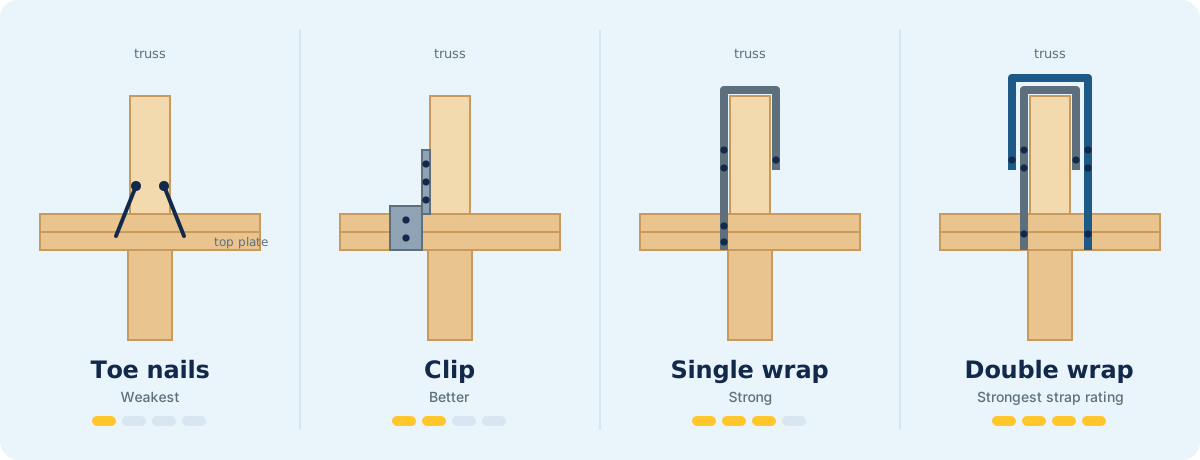
The hardware holding the roof to the walls, from toe nails to clips to single and double wraps.
Roof Geometry
Hip roofs (sloped on all sides) are classified separately from gable and other shapes.
Secondary Water Resistance
A sealed roof deck, like peel-and-stick underlayment or taped seams, that keeps water out if shingles or tiles blow off.
Opening Protection
Impact-rated windows, doors, skylights, garage doors, or approved shutters. The weakest opening sets the rating.
Roof deck attachment, up close
The form sorts deck nailing into levels. The lowest is staples or 6d nails at 6 inches on the edges and 12 inches in the field. Next is 8d nails at no more than 12 inches in the field, and the strongest wood-deck level is 8d nails at no more than 6 inches in the field. Many older Florida homes fall in the lower levels. Re-nailing the deck during a roof replacement is one of the most direct ways to move up.
Roof-to-wall attachment, up close
This question records your weakest connection, so one truss with poor hardware can set the rating for the whole house. From weakest to strongest, the categories are toe nails, clips, single wraps, double wraps, and "structural" (anchor bolts or a reinforced concrete roof). We go deeper in Hurricane Straps 101.
Secondary water resistance, up close
Standard felt underlayment doesn't count. Under the 2026 form, a sealed roof deck can be a fully adhered self-adhering membrane, self-adhering tape over every deck seam, certain double layers of underlayment, or properly applied spray foam. Most of these are much easier to add while the roof is off.
The different types of wind mitigation discounts
People talk about "the wind mit discount" like it's one thing. In practice, insurers can recognize several kinds of features, and the credits work together:
- Building code / construction era. Homes permitted under the 2001 Florida Building Code or later (or the South Florida Building Code in the high-velocity hurricane zone) are generally treated as stronger from the start.
- Roof features. Roof covering compliance, deck attachment, roof-to-wall connections, roof geometry, and secondary water resistance. For most existing homes, this is where the biggest opportunities are.
- Opening protection. Credits for protecting every window, door, skylight, and garage door with verified impact-rated products or approved shutters.
- Deductible reductions or other rate differentials. The law allows mitigation to be recognized in ways beyond a straight premium discount, depending on the carrier's filed rates.
- FORTIFIED certification. The 2026 form allows a FORTIFIED Home® Roof, Silver, or Gold certificate to back up several of the roof and opening answers.
Two points that surprise people. First, the credits are usually combined, not stacked. Carriers generally rate the combination of features your home has, so adding up individual percentages won't tell you your savings. Second, the form itself notes that some items may not qualify for a discount with every carrier.
How much can you save?
It varies by insurer, by policy, and by home. For many Florida homeowners the windstorm portion is a large part of the premium, and a strong report can make a meaningful difference there. The honest answer is that the savings can be significant but nobody can promise a figure in advance. The best way to find out is to ask your agent to price your policy with and without the features in question before you spend money on upgrades.
How to put it to work, step by step
- Find what you already have. Look for an existing OIR-B1-1802 in your closing papers or insurance file, plus the mitigation discount notice that came with your policy or renewal.
- Gather documentation. Roof permit dates, product approval numbers, and any photos from past roof or window work. Under the 2026 form, proof matters more than ever.
- Use a qualified inspector. Florida law lists who may sign the form: certain licensed home inspectors with hurricane mitigation training, certified building code inspectors, licensed general, building, or residential contractors, professional engineers, and architects.
- Submit and verify. Send the completed form to your agent or carrier, then check your next declarations page to confirm the credits were applied.
- Plan upgrades around your roof. Deck nailing, sealed roof deck, and roof-to-wall improvements are usually most practical during a roof replacement. See how we help, and also read when you don't need an upgrade.
Want an honest look at where your roof stands? Request a free roof inspection or call (941) 226-4000.
Frequently asked questions
Do Florida insurers have to offer wind mitigation discounts?
Yes. Section 627.0629, Florida Statutes, requires residential property insurers to offer discounts, credits, or other rate differentials for construction features shown to reduce windstorm losses, and s. 627.711 requires them to notify you of the available discounts at issuance and renewal. The size of the credits varies by carrier.
What is form OIR-B1-1802?
It's the Uniform Mitigation Verification Inspection Form, the single statewide form insurers must accept as proof of your home's wind-resistant features when it's signed by an authorized inspector. A revised version (Rev. 04/26) has been required for inspections since April 1, 2026.
Is my old wind mitigation report still valid after the 2026 form change?
Generally yes, for the rest of its term. A completed form is generally valid for up to five years as long as there are no material changes to the structure and no inaccuracies. Ask your agent whether a new inspection on the current form would change how your home is rated.
Which wind mitigation feature matters most?
It depends on your home and your insurer's rating plan, but roof-related features usually carry the most weight: roof deck attachment, roof-to-wall connections, roof shape, and secondary water resistance. Opening protection can also be significant if every opening is protected.
Sources
Section 627.0629, Florida Statutes · Section 627.711, Florida Statutes · Florida OIR — Wind Mitigation Resources · Florida DFS — Mitigation Notices, Inspections and Forms · Florida OIR — Uniform Mitigation Verification Inspection Form (OIR-B1-1802, Rev. 04/26) · Citizens Property Insurance — Uniform Mitigation Verification Inspection Form Changes (Mar. 19, 2026)
General information only, not insurance, legal, or engineering advice. Discounts, eligibility, and documentation requirements vary by insurer and policy, and rules change. Confirm specifics with your insurance agent or carrier.
More from Providential News
 Wind Mitigation
Hurricane Straps 101: Toe Nails vs. Clips vs. Single Wraps vs. Double Wraps
The metal straps that tie your roof to your walls are one of the most important items on a wind mitigation report. Here's how each type works and why double wraps come out on top.
 Wind Mitigation
How Providential Helps You Get Wind-Mitigation Ready, From Roof Deck to Paperwork
Better wind mitigation ratings come from two things: work done right, and proof that it was done. Here's how we help with both.
 Wind Mitigation
When You Don't Need a Wind Mitigation Inspection or Upgrade: An Honest Guide
Wind mitigation is getting a lot of attention, and for good reason. But it isn't always the right move. Here's when a roofer should tell you to wait.
Ready for a free roof inspection?
No pressure, no sales games — just an honest look at your roof from a dual-licensed contractor.
Request My Free Inspection ☎ Call (941) 226-4000