
Hurricane Straps 101: Toe Nails vs. Clips vs. Single Wraps vs. Double Wraps
The metal straps that tie your roof to your walls are one of the most important items on a wind mitigation report. Here's how each type works and why double wraps come out on top.
October 3, 2026
Key takeaways
- Roof-to-wall connections keep hurricane winds from lifting your roof off the walls. The inspection records your weakest connection.
- From weakest to strongest: toe nails, clips, single wraps, double wraps. A 'structural' category covers anchor bolts and concrete roofs.
- Double wraps run straps over the truss and nail them on both sides. That's the strongest strap category on the form and usually the best roof-to-wall rating a wood-truss home can get.
- Upgrading usually makes the most sense during a roof replacement, when the eaves are open and the work can be documented with photos.
When hurricane-force wind flows over a roof, it creates uplift, the same force that lifts an airplane wing. Your shingles or tiles, the roof deck, and the trusses all have to stay connected, and the place where the roof framing meets the walls is the critical link. If that joint lets go, the entire roof structure can lift off.
That's why the Florida wind mitigation inspection (form OIR-B1-1802) has a whole question on roof-to-wall attachment, and why hurricane straps come up so often in conversations about insurance discounts.
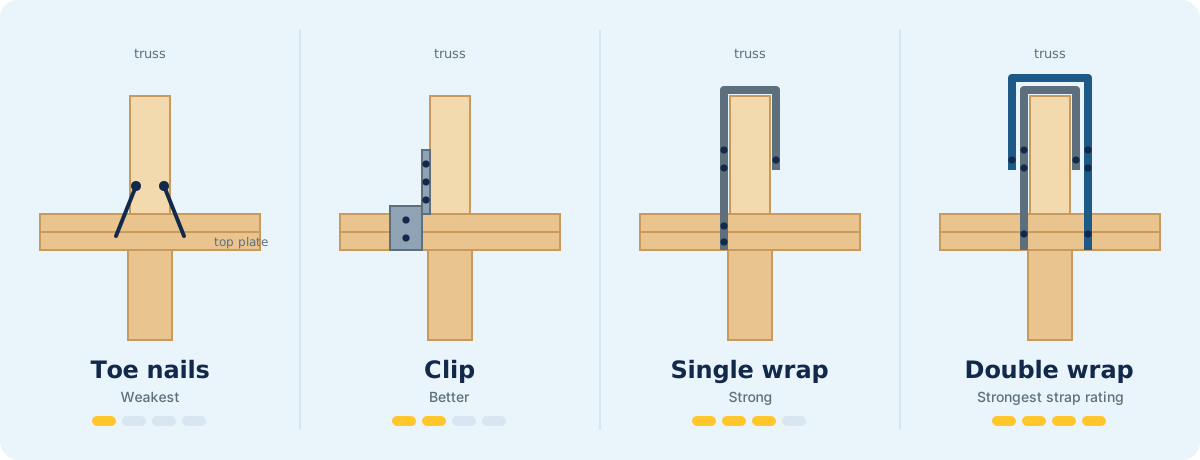
The four connection types, weakest to strongest
1. Toe nails
The truss is held to the wall's top plate by nails driven at an angle, with no metal connector at all. This is common in many older homes and is the lowest category on the form. Metal connectors that weren't installed as intended can also be classified here.
2. Clips
A clip is a metal connector nailed to the side of the truss and to the wall or top plate (or embedded in a concrete bond beam) that does not wrap over the top of the truss. A strap that wraps over but doesn't meet the nailing pattern for a wrap is also rated as a clip. Clips are a real improvement over toe nails, but they rely on nails in shear on one face.
3. Single wraps
A single wrap is a metal strap that goes up one side of the truss, over the top, and down the other side. Under the 2026 form, it has to be secured with at least two nails on one side and at least one on the opposite side. Because the strap cradles the truss instead of just pinning it from one side, it resists uplift much better.
4. Double wraps
A double wrap generally means two separate straps, one on each side of the truss, each wrapping over the top and nailed on both sides (at least two nails on one side and one on the other). The 2026 form also counts a single wrapping strap as a double wrap if it's secured to the wall or top plate with at least three nails on each side.
Why double wraps are the best strap you can get
- Two load paths. If one strap or nail group is stressed, the other is still carrying load.
- Balanced on both sides. Straps anchored on both faces resist twisting and peeling, which is how one-sided connectors tend to fail.
- Top rating for straps. Double wraps are the highest strap category on the inspection form. Only the "structural" category, which applies to anchor-bolted or reinforced concrete roof systems, rates above it. For a typical Florida home with a wood-truss roof, that usually makes double wraps the best roof-to-wall rating you can realistically get.
| Category on the form | What it looks like | Relative strength |
|---|---|---|
| Toe nails | Angled nails only, no connector | Lowest |
| Clips | Connector on the truss side that doesn't wrap over the top | Better |
| Single wraps | One strap wrapping over the truss, nailed on both sides | Strong |
| Double wraps | Two wrapping straps (one on each side), or one strap with 3+ nails on each side | Strongest strap category |
| Structural | Anchor bolts structurally connected, or a reinforced concrete roof | Highest overall |
The details inspectors look for
- The weakest link counts. The form records the weakest connection found. Hip and valley jacks within five feet of a roof corner are excluded, but otherwise one under-nailed strap can downgrade the whole house.
- Nails, gaps, and rust. Connectors need the minimum number of nails, a tight fit to the truss and blocking, and no visible severe corrosion. Missing nails or a rusted strap can drop the rating.
- Engineered connectors. Purpose-made connectors can qualify for the clip, single-wrap, or double-wrap category if they meet minimum documented uplift capacities and come with site-specific paperwork.
- Proof. The 2026 form requires at least one photo or document for each feature claimed. Your inspector will need to see the connections, usually from the attic, or have photos taken while the work was being done.
When upgrading your straps makes sense
Wrapping a strap over a truss usually takes access from above, at the eave, which is hard to get with the roof on. That's why the best time to improve roof-to-wall connections is often during a roof replacement, when the roof deck at the edges is open anyway. Upgrading makes the most sense when:
- Your roof is due for replacement. You're already paying for tear-off and access, so adding connectors adds less cost.
- Your current report shows toe nails or clips, and your agent confirms a better rating would meaningfully change your premium.
- Code requires it. On certain older site-built homes in Florida's wind-borne debris region, the Florida Building Code for existing buildings can require roof-to-wall improvements during a reroof, subject to a cost cap. Those code-required retrofits often focus on gable ends and corners, which may not change your form rating on their own. Ask whether it makes sense to go further.
- You plan to stay. Stronger connections protect the house in every storm, not just your premium.
Structural connector work is generally done by a licensed building or residential contractor, or under an engineer's design. Rules vary by jurisdiction, so check who your local building department requires. Providential holds both a roofing license (CCC1333042) and a residential contractor license (CRC1333797), so the roof and the structural work can be handled under one roof.
If upgrading doesn't pencil out for your home, that's useful to know too. Read when you don't need a wind mitigation upgrade, or start with Florida wind mitigation discounts, explained.
Frequently asked questions
What is the difference between a single wrap and a double wrap?
A single wrap is one strap that goes over the top of the truss and is nailed on both sides. A double wrap uses two separate straps, one on each side of the truss, each wrapping over the top. The 2026 inspection form also counts a single wrapping strap with at least three nails on each side as a double wrap.
Are double wraps really better than clips?
Yes. Clips attach to one side of the truss without going over the top. Double wraps cradle the truss from both sides with two load paths, which is why they earn a higher category on the Florida wind mitigation form.
Can hurricane straps be added without replacing the roof?
Sometimes, but options are limited because wrapping a strap over a truss usually takes access from above at the eave. Some connectors can be added from the attic, but they may not reach the wrap categories. A roof replacement is usually the most practical time to upgrade.
How do I know what hurricane straps my house has?
Check your existing wind mitigation form (OIR-B1-1802), which records the roof-to-wall category, or have a qualified inspector look in the attic. Our comprehensive free roof inspection also includes checking for roof-to-wall clips and telling you what type you have. If you replace your roof, ask for photos of the connections while the eaves are open.
Sources
Florida OIR — Uniform Mitigation Verification Inspection Form (OIR-B1-1802, Rev. 04/26) · Florida OIR — Wind Mitigation Resources · Florida Building Code, Existing Building (8th ed., 2023) — Section 706.8
General information only, not insurance, legal, or engineering advice. Discounts, eligibility, and documentation requirements vary by insurer and policy, and rules change. Confirm specifics with your insurance agent or carrier. Connector diagrams are simplified illustrations.
More from Providential News
 Wind Mitigation
Florida Wind Mitigation Discounts, Explained: The 9 Things Your Inspection Measures
Florida law requires insurers to offer credits for wind-resistant features. Here's what the inspection looks at, what changed in 2026, and the different kinds of discounts you may qualify for.
 Wind Mitigation
How Providential Helps You Get Wind-Mitigation Ready, From Roof Deck to Paperwork
Better wind mitigation ratings come from two things: work done right, and proof that it was done. Here's how we help with both.
 Wind Mitigation
When You Don't Need a Wind Mitigation Inspection or Upgrade: An Honest Guide
Wind mitigation is getting a lot of attention, and for good reason. But it isn't always the right move. Here's when a roofer should tell you to wait.
Ready for a free roof inspection?
No pressure, no sales games — just an honest look at your roof from a dual-licensed contractor.
Request My Free Inspection ☎ Call (941) 226-4000